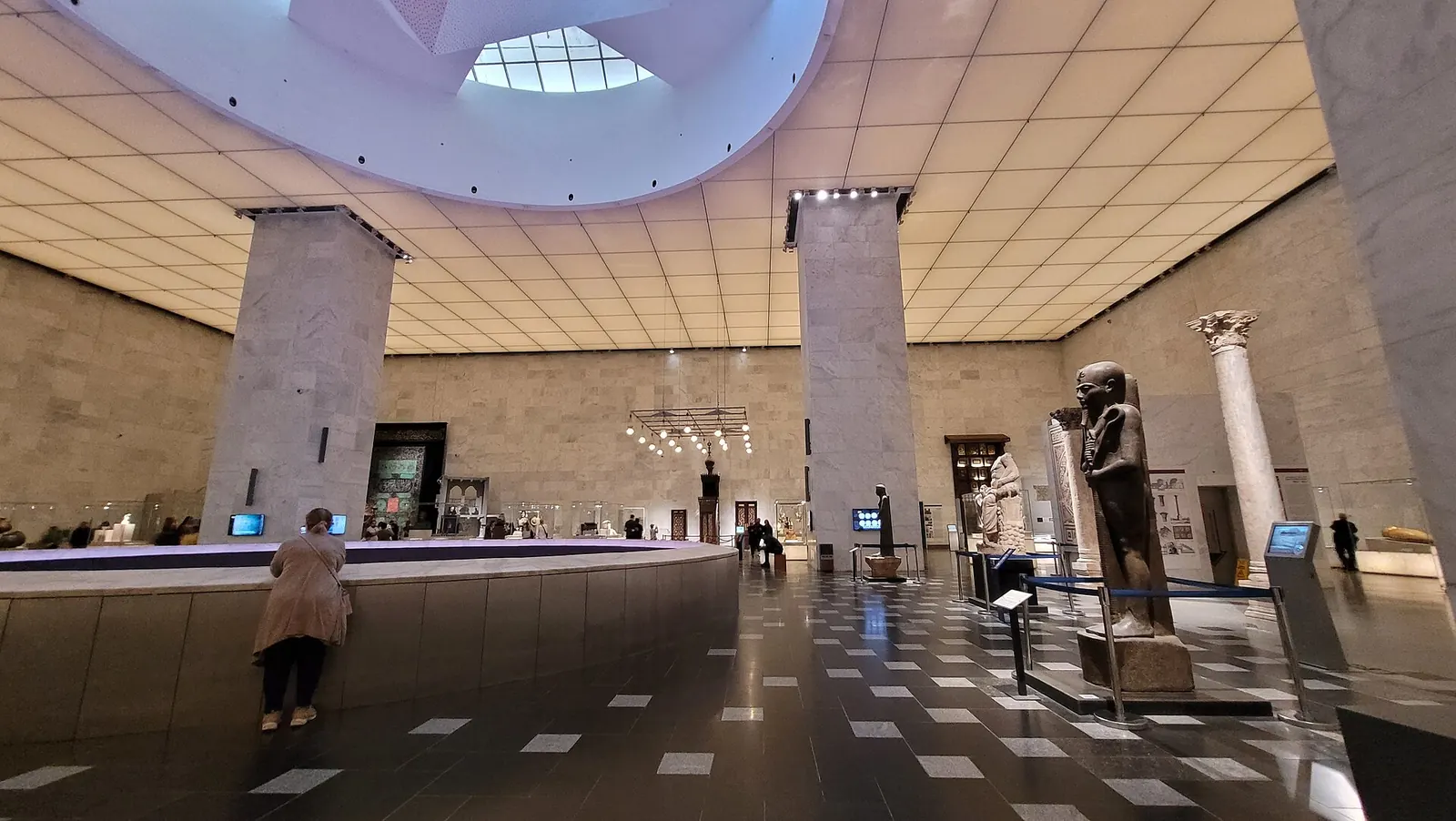
NMEC differs from an antiquities museum in both scope and organizing claim: objects from separated periods are brought together under a narrative of civilization.
IDENTITY AND SETTING
A long national story in historic Fustat.
The museum stands in a landscape associated with the early Islamic city and later urban change. This setting complicates the idea of a neutral national overview: the institution narrates many periods from a location carrying its own historical weight.
Its development across decades involved Egyptian authorities and UNESCO-supported planning. Proposal, construction, partial access and the major 2021 public opening should be recorded as distinct phases.
SCOPE AND TRANSFER
Thematic display creates new neighbours.
Objects are compared through activities such as writing, craft, belief and social life. This can reveal change across time but can also make continuity appear smoother than the evidence supports.
The transfer of royal mummies from Tahrir in 2021 is an especially visible collection biography. The hall contains human remains and requires an ethical as well as operational record.
DISPLAY AND RESEARCH USE
Comparison is the method and the risk.
- Which themes connect periods, and on what evidence?
- Where does continuity obscure rupture or regional difference?
- How are transferred collections’ earlier histories retained?
- How does the Fustat setting enter the national narrative?
The record is strongest for research into museum narrative, thematic classification, national chronology and the ethics of displaying human remains.
LIVE FIELDS
Separate the main hall from special conditions.
Hall access, photography restrictions, active exhibitions, step-free routes and opening periods require current verification. Conditions for the Royal Mummies’ Hall may differ from the rest of the museum.
Source path
Begin with NMEC and UNESCO project histories, current institutional information and scholarly work on civilization museums, national narrative and human remains.